


Byzantium and Constantinople
Byzantium was originally a settlement on the shores of the Sea of Marmara (which connects the Aegean Sea to the Black Sea through the Dardanelles and Bosporus). In AD 324, Constantine, having rejected the area around Troy as the site of his new capital (he had also considered Thessaloniki), began transforming Byzantium into his new imperial capital. A mammoth construction project commenced, reportedly employing more than 40,000 workers. Through significant financial incentives designed to attract a permanent population, the city grew rapidly. By AD 330, enough of the new capital had been completed for the city to be officially dedicated on May 11. Named Constantinople in honor of the emperor, the city adopted a system of municipal administration modeled on that of Rome.
Over the following centuries, Constantinople grew into one of the largest, wealthiest, and most influential cities in the world. Known as a political, religious, and cultural center of the Eastern Roman Empire, this was later known more often as the Byzantine Empire. Protected by deep defensive walls constructed during the reign of Theodosius II in the fifth century, the city withstood numerous sieges by Persians, Arabs, Bulgarians, and other invading forces.
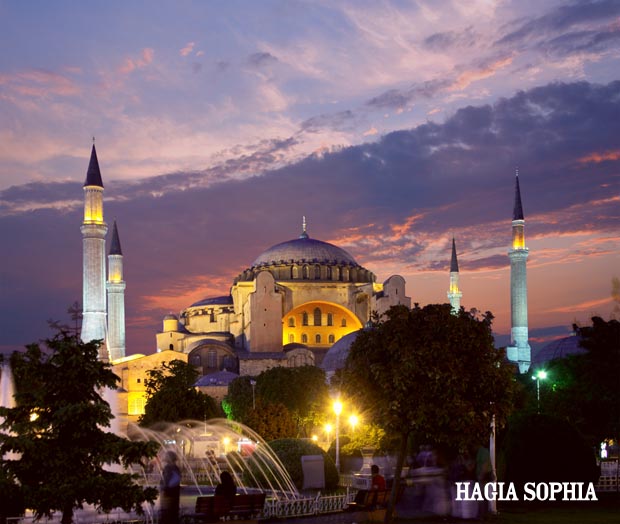
Under Emperor Justinian I in the sixth century, Constantinople experienced a period of extraordinary architectural and cultural development, most famously represented by the construction of the great cathedral of Hagia Sophia in AD 537. The city also became a principal center of Eastern Orthodox Christianity, particularly following the "Great Schism" between the Eastern and Western churches in 1054.
Although Constantinople survived centuries of military threats, it suffered a devastating blow in 1204 when armies of the Fourth Crusade captured and plundered the city, establishing a short-lived Latin Empire.
Byzantine rule was restored in 1261, but the empire never fully recovered its former wealth, territorial power, or defensive strength. By the fifteenth century, Constantinople was the capital of an empire reduced to little more than the city itself and a few scattered territories. On May 29, 1453, after a siege lasting nearly two months, the Ottoman Turks under Sultan Mehmed II breached the city's defenses and captured the city, bringing the Byzantine Empire and its more than eleven centuries of history to an end.
Justinian I , also known as Justinian the Great, was the Eastern Roman emperor from 527 to 565. He lived 482 AD - 565 AD.
Description of the original Hagia Sophia of Justinian I from the book History of the Byzantine Empire by George Ostrogorsky
See more Greece History
Original Page July 2020 | Updated November 12, 2026
Greece 112 Emergency Announcements on X/Twitter
Hellenic National Meteorological Service

Greece's Golden Visa program
Advertisement: I am an Amazon affiliate
Fodor's Essential Greece: with the Best of the Islands (Full-color Travel Guide) – Amazon
- Illustrated experiences guide to the top things to see and do
- Multiple itineraries to help organize your days
- 40+ detailed maps for easy navigation
- Color photos throughout
- Local recommendations for sights, dining, hotels, nightlife, shopping, and activities
- “Best of” features covering beaches, food and drink, and more
- Trip-planning tips on when to go, getting around, avoiding crowds, and saving money
- Historical and cultural insights into Greek people, art, architecture, and cuisine
- Special features on the Acropolis, Greek gods and heroes, Greek history, Meteora, and more
- Local writers highlighting lesser-known places
- Greek-language primer with useful words and phrases
- Up-to-date coverage of Athens, Santorini, Mykonos, Crete, Corfu, Rhodes, the Aegean, Sporades and Saronic islands, Delphi, Central Macedonia, Meteora, and the Peloponnese
- 800 Pages