Rick Steves' Greece: Athens & the Peloponnese amazon.com

Bust: Greece, the Euro and the Sovereign Debt Crisis - By Matthew Lynn amazon.com

Greece's 'Odious' Debt: The Looting of the Hellenic Republic by the Euro, the Political Elite and the Investment Community - By Jason Manolopoulos amazon.com

Understanding the Crisis in Greece: From Boom to Bust - By Theodore Pelagidis amazon.com

The Imminent Crisis: Greek Debt and the Collapse of the European Monetary Union amazon.com

Eyewitness Greece - Athens and the Mainland - 352 Pages

Financial markets and economic growth in Greece, 1986-1999 [An article from: Journal of International Financial Markets, Institutions & Money]
Though heavily critiqued from the obvious quarters (PASOK and New Democracy) and even from others, such as more natural coalition partners like the Democratic Left (Dimar), Tsipras seems certain that the eurozone will bend backwards even further to keep Greece in the EU, and that new elections in June will consolidate even further gains into the Greek parliament, where from the elections on May 6 Tsipras' Syriza party won 16%, only behind New Democracy in vote totals. A new vote could put Syriza out ahead of ND, perhaps even gaining enough of a majority vote to not require a coalition with ND or PASOK at all.
The deadline for formation of a new government is May 17, in which case a new election in June will be initiated automatically.
Most comments I have read say that PASOK and New Democracy dread new elections as it will almost certainly erode even further their thinning power within Greek politics.
Results from the May 6 election are quite convoluted, and the only way to continue using the May 6 results are if leaders of PASOK, New Democracy and the Alexis Tsipras of Syriza can agree on a platform for going forward with a coalition government. Since Tsipras has been advocating tearing up the austerity agreements that have been such a heavy part of Greek life since the advent of the serial bailouts from the eurozone which began in 2009, such a coalition seems unlikely.
News outlets are cropping up with new stories on a Greek exit from the eurozone, which by now has become boilerplate from so many crisis over the last years. But there is a new twist in that Tsipras has been aggressively pushing for Samaras of New Democracy and Venizelos of PASOK to notify the EU and IMF that the new election results have voided all prior agreements. Samaras response is that Tsipras is calling for the destruction of Greece.
If new elections are slated for June, it will require Greek voters to back either the existing painful labor of austerity with New Democracy, or to push toward a radical departure into uncharted avenues under Tsipras' Syriza.
The 300 seat Greek parliament has been up-ended by the vote which has plunged PASOK from a landslide victory in 2009 to a third place finish behind New Democracy and Syriza.
The projected results are:
New Democracy 19.7% 110 Seats
Syriza 16.33% 50 seats
PASOK 13.54% 42 Seats
Independent Greeks 10.47% 32 Seats
KKE Communist 8.38% 26 Seats
Golden Dawn 6.89% 21 Seats
Dimar 6.04% 19 Seats
The Wall Street Journal is saying these results show Greek society at its most segmented since the end of the Junta in 1974. The multiplicity of parties that could hold seats means coalitions must be constructed, or a new round of voting will be forced.
The biggest shock may be the gains held by the anti-immigrant Golden Dawn party, which has a topsy-turvy history of beliefs and ideological and is typically described as neo-nazi.
Konstandaras at eKathimerini (Yesterday Strikes Back") says "Voters destroyed the 2-party system, fragmented the center and brought the extremes into the center of developments."
Official Athens has got a frown on, and it's getting bigger. This from Businessweek:
"Some economists fear that politicians may be tempted to relax their focus on reforms after the elections.
"Domestic and overseas conditions do not allow for the slightest complacency or relaxation ... Full readiness is required the very day after the election campaign ends," central bank governor George Provopoulos told the bank's annual general assembly. "
This from Reuters:
"Greece's economy will contract a deeper than expected 5 percent this year, the country's central bank chief said on Tuesday, piling more pressure on to a citizenry already battered by crippling austerity and record joblessness.
The projection topped a previous forecast the central bank made in March, when it projected the 215 billion euro economy would contract 4.5 percent after a 6.9 percent slump in 2011. Twice bailed-out Greece is in its fifth consecutive year of recession.."
Hans-Werner SInn, the president of the German economic IFO Institute has urged Greece to drop the euro in order to regains competitive position and to reverse the ongoing job losses. Complete articles on Sinn's comments are at Reuters and the UK Telegraph:
"Greece's ability to recover competitive economic standing will be severely constrained if it continues to use the euro, and other indebted euro zone countries will likely face similar struggles, the head of Germany's prominent Ifo economics institute said on Monday.
"I personally believe there's no chance for Greece to become competitive (while) in the euro zone," Hans-Werner Sinn, president of Ifo, said in a luncheon speech in New York.
"If Greece is kept in the euro zone, there will be ongoing mass unemployment. But if they exit, they will see a very sudden recovery," he said, as lower prices boost competitiveness."
Hans-Werner Sinn goes on to say that the crisis in Europe has been needlessly prolonged and complicated by way of the European Central Bank's endless credit allowances for Greece and the other damaged economies of the eurozone.
With elections set for May 6, the Greek political parties are in a fight to present their own idea of how to solve the crisis, and to sell those notions to the Greek populace that has had its patience thinning step by step as the pain of austerity and the revelations of government malfeasance over the last decades has created bitter resentments. Article written by Anthee Carassava at the Washington Post:
“This is the worst financial crisis in contemporary history,” The Socialists “brought us to the verge of an unruly default with the most catastrophic consequences,” and “Unemployment is our society’s worst plague.”
...Throughout his 60 minute speech, Samaras, a tall, athletic-looking man of 60, mixed patriotic paeans with bitter bites and slights against PASOK — the Socialist party with which he begrudgingly teamed up in November to push through a landmark loan and debt restructuring deal that brought Greece back from the brink of default.
Still, as he spoke of hard-nosed, business-minded economics, such as slashing corporate tax from 23 percent to 15 percent, spurring economic recovery and handing management of money losing monopolies to private executives to cut public waste, he struck a chord with voters on his Greek rendition of compassionate conservatism.
...Samaras, though, has always been a bit of a renegade, from his college years at Amherst University — where he dropped his pre-med studies to join the ranks of economics after a motivating speech by John Kenneth Galbraith — to his erratic career in politics.
Infused by the abrasive rants of radical thought that gripped the 1970s, great groundswells of popular movements influenced his thinking, pushing him to break out of his sheltered aristocratic upbringing and alter his values and even his looks.
At one point, he ditched his usual blue-blazer and gray slacks, sported jeans and a scruffy Van Dyke to show his defiance to the Greek military junta, which, among other things, banned beards during its 1967-1974 rule of the country. He was also detained after joining hundreds of other students in blocking traffic at Westover Air Force Base, to protest new Vietnam War policies in 1972."
Samaras has been in leadership for New Democracy since 2009.
The Wall Street Journal article on the on-the-books and off-the-books manipulations that are part of the list of debt rankings that is currently haunting the eurozone:
The debt of the euro region rose last year to the highest since the start of the single currency as governments increased borrowing to plug budget deficits and fund bailouts of fellow nations crippled by the fiscal crisis.
The debt of the 17 euro nations climbed to 87.2 percent of gross domestic product in 2011 from 85.3 percent the previous year, official European Union figures showed today. That’s the highest since the euro was introduced in 1999. Greece topped the list with debt at 165.3 percent of GDP, while Estonia had the least at 6 percent of GDP.
The Economist predicts: "The voters may be unhappy, but the election will not change much"
"Opinion polls suggest that the May 6th vote is unlikely to produce a clear result. Yet the leaders of the PanHellenic Socialist Movement (Pasok) and the conservative New Democracy (ND) party, fractious coalition partners for five months, are spoiling for a fight, even if their parties end up joining forces in government again.
The voters are angry with ND over a public-spending spree that set Greece on the road to ruin, and with Pasok for failing to haul it back from the brink. ND has a modest but persistent poll lead. But Antonis Samaras, its leader, trails Evangelos Venizelos of Pasok by a small margin as the better choice as prime minister. Many Greeks plan to abstain. "
In the wake of the public suicide of Dimitris Christoulas at Syntagma Square, the questioning by Greeks (and sometimes self-flagellation) has continued. This from the New York Times:
"In a handwritten note found near the scene, the pensioner said he could not face the prospect “of scavenging through garbage bins for food and becoming a burden to my child,” blaming the government’s austerity policies for his decision."
With the leadup coming for the expected elections in May, the impact of the turmoil has become more raw and difficult in the Greek press. See this "Firing Squads and Nooses" comment from Kathimerini:
"For starters, Greeks will have the chance to do this via the ballot box in a few weeks’ time. If the value of this most ancient of democracies is to be restored, then voters must use the general elections due to take place next month to inject some purpose into the system. Rather this than nooses and firing squads."
The votiong date is expected to be announced this week. The article from Kathimerini is titled "Greece's long, painful suicide" written by Nick Malkoutzis.
At the moment, New Democracy has the advantage:

These polling numbers were published in the following places:
The Kappa numbers were published in To Vima
The MRB numbers were published in Real News Greece
The MARC numbers were published in Ethnos
Unemployment in December rose by 3,920, putting the official unemployed persons number at 1,033,507.
GDP decline of -7.0% for the fourth quarter. 2.3% increase in the consumer price index (inflation).
If "Collective Action Clauses" are implemented by the Greek government in order to force bond-swaps, this would trigger both an insurance event (if then classified as a 'credit event') by the International Swaps and Derivatives Association, and the credit ratings agencies could then declare the action a defacto default.
WIth the pressure on to push as many bondholder groups into the swap-deal, one of the surprising holdouts were six of the fifteen state-run Greek pension agencies.
Greece has €14.5 billion bond maturities to pay on March 20, and the tranche payment from the latest troika deal is being held until a deal is clinched with the private investors.
Last week Fitch downgraded Greece to "C" and Moody's announced a cut coming which will place Greece to the credit agencies lowest rating. The S&P rating moves Greece to "D".
The reasoning given for the Standard and Poor's action is the result of the use of 'collective action' which is meant to force investors holding Greek paper into the "haircut" which is a central element of the recently negotiated Trioka-led agreement. S&P will be rating the new Greek exchange bonds as "Double-C."
News on the cut : Bloomberg, Wall Street Journal, Forbes
The latest deal to stave of bankruptcy of the Greek state features a €107 billion write-off of existing Greek debt, and €130 billion in new funds. The "Troika" (IMF, European Central Bank and European Commission) is creating a management monitoring team that will supervise Greek state finances. Considering the number of missed targets on state payroll cuts, selling state properties, etc., this appears to be the juncture of where Greece and the EU either succeed (by being under the supervision of the EU apparatus) or debt default occurs. Implementation of agreed upon debt-reduction efforts has been the bane of recent negotiations, despite Greek parliament voting through approval of treaty terms. Questions of credibility of whether Greece will follow through with treaty obligations has prompted the demands for some method of supervision (and presumably, enforcement). The most recent treaty terms from the negotiations in Brussels are:
Greece will reduce debt to 120.5% of GDP by 2020 (it is currently at 160%)
Private investors holding Greek debt take losses of 53.5% on the value of bonds
Eurozone will bring experts into Greece to supervise implementation of the austerity program
Greece must amend its constitution making debt repayment priority over government functions
Greece is required to have a standing special account which holds money for debt repayment, solvent for three month intervals
Cuts must be made to pensions, reduction in the national minimum wage, reductions in health-care and defense spending, requirements to complete agreed upon layoffs of state employees and follow-through on state asset sales.
All of this is happening while Greece deals with 20% unemployment, a fifth year of recession and economic contraction, and continued strikes and various expressions of social unrest. On top of that is an April vote in which the temporary leadership of Interim Greek prime minister Lucas Papademos will come to an end, and the new government could cast off all agreements, immediately shunting Greece into bankruptcy and a eurozone exit.
Though few commentators are taking the refusal from certain political figures within the Greek parliament to cut pensions as real, versus a demonstration of "political theater," the latest EU/IMF/ECB Troika managed bailout deal nonetheless appears to be near the finish line, allowing Greece to receive the next expected tranche payment of to meet the cost of paying off maturing bonds coming due in March.
Jacob Funk Kirkegaard, research fellow at the Peterson Institute for International Economics, said the lack of progress made during Wednesday's talks highlights the "certain amount of political theater involved here."
"The political leaders in Athens are campaigning," he said. "They need to be seen by the Greek population as fighting until the very last drop of blood. ... They are facing off against the Germans and IMF and the rest of the world." Complete article at CBS News
Cut the Greek minimum wage by 20-22%
Cut the Greek state employee roll by 15,000 workers in 2012
Cut €300 million from pensions
The European Central Bank will exchange bonds purchased on the secondary market for below face value, eliminating some €11 billion in Greek payment liabilities.
The Elstat Statistical Agency released information on November 2011 employment figures:
"Unemployment rate in November 2011 was 20.9% compared to 13.9% in November 2010 and 18.2% in October 2011. The number of employed amounted to 9,901,269 persons. Τhe number of unemployed amounted to 1,029,587 while the number of inactive to 4,423,657. The corresponding figures for November 2006 to 2011 are presented in Table 1.
The number of employed decreased by 405,785 persons compared with November 2010 (a 9.4% rate of decrease) and by 164,506 persons compared with October 2011 (a 4.0% rate of decrease).
Unemployed increased by 337,010 persons (a 48.7% rate of increase) compared with November 2010 and by 126,062 persons compared with October 2011 (a 14.0% rate of increase).
Inactive persons –that is, persons that neither worked neither looked for a job– increased by 102,730 persons (a 2.4% rate of increase) compared with November 2010 and by 41,301 persons compared with October 2011 (a 0.9% rate of increase).
Tables 2 and 3 illustrate unemployment rate by gender and age groups from November 2006 to 2011. Table 4 presents the evolution of unemployment rate during last 12 months by Decentralized Administrations. Finally, Table 5 presents 95% confidence intervals1 for monthly estimations of unemployment rate for November 2011."
Download the Information PDF (containing the above mentioned tables) from Elstat here.
Gender divided statistics indicate Greek female unemployment in Nov '11 at 24.5%, and Greek male unemployment at 18.3%
Interim Greek prime minister Lucas Papademos continues to contend with German Chancellor Merkel and French President Sarkozy as negotiations to pull Greece back from a certain plunge into bankruptcy continue in Paris. With pressure on the Greek parliament to meet the demands of the Troika of the European Commission, the International Monetary Fund and the European Central Bank, a lot of back-door dealmaking seems to be going on.
In the past several years, Greece has agreed to and voted through several variations on the austerity program put together to meet the economic crisis, but has consistently dragged its feet on implementing key provisions beyond the passage of laws making them possible. The (non) firing of state employees and the (non) sale of particularly poor-performing state-owned properties have been sources of frustration for the european powers who contend they've yet to see any real progress in those areas.
Some of the coverage:
"Time is running, says Merkel!" at the Bloomberg Business News
Final terms of new rescue package being decided Tuesday Wall Street Journal "Greece will fire 15,000 Public-Sector Workers by End of 2012"
The Papademos government is juggling dual-talks with bond-holders and public creditors with the March tranche payment hanging in the balance. There is a €14.4 billion bond payment due in March, and without the funds available there would likely be a quick bankruptcy, default, and Greek exit from the eurozone. All parties are saying they do not want this calamity to occur, the ramifications being unpredictable and setting a precedent that might be followed by other heavily-debted EU countries. The scramble for a solution that fits all parties; the European banks, the political leadership, Greek public opinion and all the creditors big and small seems like a near impossible task. Only the fear of what follows bankruptcy seems to be keeping all heads returning to the negotiation tables.
"...creditors have said they would be willing to accept a loss of 70 percent on their new bonds, Greece and its backers have been pushing for more by demanding that these securities carry an interest rate below 3.5 percent.
Greece is effectively bankrupt, staggering under a debt load that the I.M.F. now estimates as equal to about 160 percent of its gross product." New York Times
Citing failure to implement agreed upon austerity measures (such as laying off 30,000 government workers, of which less than 1,000 have been let go), Germany is demanding an EU appointed budget control office that would follow through on treaty obligations by using the power of veto, among other powers, over Greek public spending.
"Germany is continuing its push for controls over Athens' budget, despite being rebuffed by Greece and other euro-zone countries at Monday's European summit.
Behind Chancellor Angela Merkel's quest for strict supervision of Greek spending lies growing frustration in Berlin that Greece has failed to meet its deficit-cutting targets or overhaul its economy, which were the conditions of its €110 billion ($145 billion) bailout in 2010. "
Much more on this at the Wall Street Journal
In related news, the EU powers that be are simply going to pass a law that forbids overspending:
"All European Union countries except Britain and the Czech Republic agreed Monday to sign a new treaty designed to stop overspending in the eurozone and put an end to the bloc's crippling debt crisis, while EU leaders also pledged to stimulate growth and employment.
The new treaty, known as the fiscal compact, was agreed at a summit of European leaders in Brussels on Monday. "
Well, that was easy! Article at the AP.
Article by Yanis Varoufakis at cnn.com which lambastes the maneuvers throughout the crisis over Greek debt as a refusal to submit to the truth of the situation, made worse from political hubris:
"Beating their chests about the German threat to Greece's national sovereignty, they are hoping that the Greeks will somehow forget that it was they, their leaders, who ceded sovereignty to the so-called troika of the European Commission, the International Monetary Fund and the European Central Bank.
This is a typical case of a shady coalition of vested interests that is disintegrating under the weight of its collective hubris. For the past 18 months, German and Greek leaders have been working together to deny the truth about three simultaneous bankruptcies: The irreversible bankruptcy of the Greek state, the effective insolvency of many Franco-German banks, and, last but not least, the unsustainability of the euro-system as we know it."
If the Greek government won't implement all of the steps agreed to in the various treaty arrangements to finance debt payments, why not just take away their ability to stop it? With sovereign budget control in the hands of euro zone-appointed commissioners, the saving of the Greek economy (or final annihilation of it) could be completed quickly in order to hit reduction targets. This simple idea (from Germany) has had the effect one might expect: outrage. Article at Financial Times.
"EU and International Monetary Fund officials have already presented the Greek government with a 10-page list of “prior actions” Athens must take before being granted the new bail-out. The list, obtained by the Financial Times, includes cutting 150,000 public sector jobs within three years and cutting this year’s budget deficit by a further 1 per cent of economic output.
...The German plan, which was circulated on Friday and would also force Greece to pay its debt obligations before spending any money on normal government expenditures, caught Mr Papademos and other eurozone governments by surprise. Officials said it was unlikely to be adopted.
“The Germans have a lot of influence but that goes a little beyond the limits the outer member states could support,” said a senior official involved in the discussions. “If you went with that model you’d do away with the normal democratic decision-making in a member state.”
The lead at the Wall Street Journal
Frustrated with the slow pace of implementation of budget reforms in Greece, Germany is leading a push to force Athens to cede some control over its budget decisions to Europe as a condition of disbursing the next tranche of international aid for the beleaguered country.
The question within all of the treaty negotiations for years now has always been would Greece sell off anything of real value in order to stay in the EU (for example Aegean Islands, or renting out historical monuments, or ceding financial control). So far the answer has always been "no*," and anytime the idea is fielded in Greece the usual contradiction is expressed: Greece wants to stay in the EU but not if it means losing any element of national identity. This yes/no answer continues to influence every move of the Greek legislature, which will approve (with often a great deal of agony) treaty agreements which mean tearing down a half-century of economic and political arrangements that benefit and protect the various ruling parties and their clients (principally unions). But when it comes to following through, very little happens.
More about the leaked Berlin proposal to adminster the Greek budget at eKathimerini (English).
(*One exception is the creation of the Elstat statistical agency, an independent body to provide reliable measurements of Greek economic activity.)
Amid the political wrangling over what to do about vacillating support for eurozone "emergency funds" and what the level of input from various countries should be (particularly Germany, which is balking at the huge sums being suggested) there is the coalescing demands of private investors who view the ECB's refusal to join in the haircut (which could be as high as 65% to 70% of holdings) as grossly unfair and a violation of prior agreements. Many investors are complaining that they took on the bonds while listening to the commitments of the ECB and other political leaders who pledged to see that default (and 70% haircuts!) never happened. Article at eKathimerini.
Wall Street Journal article that surveys the personal experiences of 30 people in the eurozone facing austerity and other challenges. Article online at Wall Street Journal.
New York Times piece by Rachel Donadio on the hapless progress of politics in Athens:
“It’s an implosion — it’s an endless sequence of implosions from bad to worse, to worse, to worse,” said Yanis Varoufakis, an economics professor at the University of Athens and commentator on the Greek economy. “There’s nothing to stop the Greek economy losing 60 percent of its G.D.P., given the path it is at.”
...There is ample evidence of Greece’s political dysfunction. About a year ago, after missing earlier fiscal targets, Greece promised to sell off $65 billion in state assets as a condition for receiving emergency loans. So far, though, it has sold only about $2 billion worth, because of domestic opposition and a reluctance to part with assets at what the government says are fire-sale prices.
The country also pledged to lay off public-sector workers, overhaul tax collection, and make its economy more competitive. But it has fallen short in those areas as well. A law passed in the fall called for cutting 30,000 public jobs by shifting workers into a labor reserve at much lower pay, but only 1,000 workers have been so assigned.
Adding to the sense of déjà vu, last week, the Greek Parliament began debating a bill that would streamline some state entities and open the professional associations governing lawyers and truck drivers, among others — measures it passed in 2010 but never put into effect. "
The bottomline:
"...Officials from the so-called troika of foreign lenders to Greece — the European Central Bank, European Union and International Monetary Fund — have come to believe that the country has neither the ability nor the will to carry out the broad economic reforms it has promised"
The political impasse ruling Greek implementation of treaty obligations, and the sheer weight of the math will bring the bailout on Greece to an end in March when Germany and France refuse to back more money to Athens to pay for maturing bonds. Or, maybe not: there seems to be an endless patience with Athens since so much is at stake that affects all of Europe, and the world.
"...The likeliest outcome is a last-minute deal, with all but a relative handful of creditors taking part."
"...AS EUROPE GOES, so may go the U.S. and global economies. Europe’s fate, in turn, hinges on what happens in Greece, whose debt crisis triggered the broader predicament of the euro and the 17 nations that use it. Alas, the news from Athens is not bright. Not only did Greece fail to meet its deficit reduction and growth targets for 2011, with a further deep recession forecast for 2012, but negotiations to write down the $260 billion in Greek debt held by the private sector have bogged down."
Read the entire Washington Post article.
Washington Post article about the dilemma facing the United States (and the world) regarding the changing attitudes of Turkey.
Washington Post article by Jackson Diehl:
[from a Republican Presidential debate event]
"Baier delivered a mostly accurate but extremely one-sided description of the government of Recep Tayyip Erdogan, saying that since his “Islamist-oriented party took over . . . the murder rate of women has increased 1,400 percent. Press freedom has declined to the level of Russia. [Erdogan] has embraced Hamas, and Turkey has threatened military force against both Israel and Cyprus.” Then he asked: “Do you believe Turkey still belongs in NATO?”
Perry responded: “Well, obviously when you have a country that is being ruled by what many would perceive to be Islamic terrorists . . .”
Islamic terrorists? This, mind you, is about a government that has just stationed an advanced radar on its territory that could be used to track and shoot down missiles from Iran; that joined the NATO operation against Moammar Gaddafi in Libya; that has become the host of the opposition to Syrian dictator Bashar al-Assad; and that, having repeatedly won free democratic elections, amended Turkey’s constitution to expand rights for women, ethnic minorities and unions.
Okay — that, too, was a one-sided account of the Erdogan record. But that is precisely the point: Turkey has become a complex, dynamic, difficult, sometimes infuriating, sometimes very helpful and indisputably important ally of the United States. In that sense, Erdogan’s government is a paradigm of the relationships U.S. administrations will be managing — if we are fortunate — in Egypt, Iraq and elsewhere in the Arab Middle East during the coming decade.
The reality is that, like it or not, “Islamist-oriented” governments are about to become the new normal in a region dominated for decades by secular autocrats and pro-American generals."
Washington Post article by Anthony Faiola asks the obvious question: is austerity even working? Many economists and pundits have been suggesting since May 2010 (when the bailout out treaty was negotiated) that Greece is paying too heavy a price for so little of a result (staying on the euro).
Washington Post article:
"Greece has been forced to cut spending and raise taxes in the middle of a severe downturn, slashing pensions as well as state salaries, jobs and services. As public confidence has evaporated, consumer spending — the biggest driver of the economy — has plunged, generating cascading losses at private firms. The result is a dizzying economic plummet and social crisis that is bringing the cradle of Western civilization to its knees."
€47.1 billion has been delivered to Greece thus far from the May 2010 loan treaty. There is an estimated total of €360 billion in Greek public debt. There are ongoing efforts to negotiate a 'haircut' reduction on debts with private lenders with a goal of eliminating €160 billion altogether.
But the biggest challenge is now coming in March 2012: nearly €30 billion is due on maturing debt, and without another tranche payment at that time from the overall bail-out treaty, Greece will be forced off the euro and into national bankruptcy.
Greece development minister Michalis Chryssochoidis announced that deficit reduction targets (target of 9%) were missed but still better than the 2010 deficit of 10.6%. The Fitch credit agency then warned that the missed target indicates Greek potential for pulling the eurozone into further crisis, though the Fitch overall outlook is low probability of a euro breakup (January 5 "Risk Radar" report). Fitch has suggested most important arena for such a result is with the burgeoning Italian debt problem, which greatly exceeds Greece's numbers.
Washington Post article:
"Greece has been forced to cut spending and raise taxes in the middle of a severe downturn, slashing pensions as well as state salaries, jobs and services. As public confidence has evaporated, consumer spending — the biggest driver of the economy — has plunged, generating cascading losses at private firms. The result is a dizzying economic plummet and social crisis that is bringing the cradle of Western civilization to its knees."
The Czech central bank Governor Miroslav Singer makes some obvious points about the scale of Greece's problem, both for itself and to the euro at large:
Reuters article:
"Greece should leave the euro zone and devalue its new currency unless Europe is willing to provide "massive" funding for the indebted country, Czech central bank Governor Miroslav Singer said in a newspaper interview.
"If there is not the will to give Greece a massive amount of money from European structural funds, I do not see any other solution than its departure from the euro zone and a massive devaluation of the new Greek currency," he said in the interview to be published on Monday.
"So far Greece has been given loans that served mainly for buying time and for rich Greeks to move their money out of the country. This lowers the trustworthiness of Europe and the willingness of non-European countries to lend or provide new capital to the International Monetary Fund for helping Europe."
The next tranche payment from the €110 billion ($152.6 billion) bailout has been pushed back, with a March deadline apparently the make or break for the government in Athens under Lucas Papademos (if Greece makes it through again, the next payment will happen in June 2012).
"The schedule for Greece to receive payments under its first EUR110 billion bailout package has been pushed back by three months so Athens will receive the next tranche in March, European Commission spokesman Olivier Bailly said, if Greece implements its policy commitments."
New York Times article:
"There are increasing signs that Greece will fail to make the structural changes to its economy that its leaders have promised. Greek’s prime minister, Lucas Papademos, warned last week that without deeper spending cuts a disorderly default was a possibility, and could result in Greece leaving the euro.
....A drumbeat of bad economic news lately has led many economists to predict the imminent return to recession for many of the countries that use the euro. At the same time, European countries and financial institutions need to raise roughly $2.4 trillion in 2012."
And the frequent "warning" is issued again:
"There are increasing signs that Greece will fail to make the structural changes to its economy that its leaders have promised. Greek’s prime minister, Lucas Papademos, warned last week that without deeper spending cuts a disorderly default was a possibility, and could result in Greece leaving the euro. "
More about the Tranche:
Summary of New Fiscal Plan - Called "The Midterm" or "Troika Plan"
It has been a long-running attribute of the austerity program that Greek banks were being emptied of deposits. Some of the money was being withdrawn to get it out of the country because of not only the fear of default of Greek financial institutions, but because of the increased tax penalty scrutiny. Money was moved to Crete and into other obvious locations (Switzerland, the United States) with an eye toward reaping a profit from the balance if or when the Greek drachma reappeared. Expecting a devaluation to follow quickly on the heels of a reborn drachma, euro money would automatically bring the holder an increase when converted into the lower valued drachma (of course, this only works if the euro stays around long enough to see a reborn drachma in the first place).
But in the last year, depositor flight has been an even shorter trip: from bank account into mattresses.
Der Spiegel article:
"Georgios Provopoulos, the governor of the central bank of Greece, is a man of statistics, and they speak a clear language. "In September and October, savings and time deposits fell by a further 13 to 14 billion euros. In the first 10 days of November the decline continued on a large scale," he recently told the economic affairs committee of the Greek parliament.
With disarming honesty, the central banker explained to the lawmakers why the Greek economy isn't managing to recover from a recession that has gone on for three years now: "Our banking system lacks the scope to finance growth."
He means that the outflow of funds from Greek bank accounts has been accelerating rapidly. At the start of 2010, savings and time deposits held by private households in Greece totalled €237.7 billion -- by the end of 2011, they had fallen by €49 billion. Since then, the decline has been gaining momentum."
Despite ongoing fighting inside the Prime Minister Lucas Papademos government, meetings in Brussels apparently satisfied requirements to have the sixth loan installment released.
eKathimerini on the scene
"However, the mood in the cabinet meeting is unlikely to be celebratory. Sources said that Papademos has expressed concern about the disagreements between ministers and what impact this might have on his government’s attempts to meet the targets set by Greece’s lenders.
Sources added that Papademos is less concerned about squabbling between cabinet members from the three parties taking part in the interim government than between ministers from PASOK.."
Nice interactive world map that shows the credit ratings for sovereign nations around the planet. That's right: Greece has a burning red "substantial risk" rating at present.
With national ratings and global banks all experiencing a phenomenon of credit rating 'adjustments', I don't know for how long this chart will be accurate.
Entire chart at chartbin.com
What's next? With New Democracy leader Antonis Samaras not willing to support new austerity measures, Papademos has to lead this 'revised' Greek government to produce a plan that'll please the EU leadership and the boiling Greek public.
eKathimerini polls from this weekend indicate the mood:
"An opinion poll for Sunday’s Kathimerini found that a total of 55 percent of Greeks welcomed Papademos’s appointment while 18 percent had a negative view, according to the poll carried out by Public Issue.
The survey also found that more than 70 percent of those questioned applauded the decision of the two main parties -- socialist PASOK and conservative New Democracy -- to move toward the formation of a unity government.
The survey also asked respondents what they believed the country’s biggest problems were. Six in 10 (58 percent) said the economy, 34 percent cited rising unemployment, while 29 percent saw Greek politicians and the political system as the country’s biggest burden."
The talk of Greece going back to the drachma has been heard throughout the entire debacle of loans/debt crisis that started in 2009. But the possibility has never been more real than this week when Papandreou pushed for a referendum on austerity and a confidence vote for his government which is looking like the opt-in (or opt-out) vote for remaining in the EU. With so much seemingly in the air, drachma rebirth is looking more real (CNBC):
"So now it is time to ponder the once unthinkable: that Greece might end its 10-year use of the euro and return to its former currency, the drachma.
Such a move is still officially anathema in Athens. But a growing body of economists argues that it would be the best course, whatever the near-term financial and economic implications. And now, with a referendum on the European-led bailout facing Greek voters, a vocal minority that has long called for a return to the drachma might find itself with a growing group of listeners.
A return to the drachma is unlikely to offer a quick cure for Greece’s ills. Default on the nation’s $500 billion in public debt would become a certainty, depositors would take their money out of local banks and, with a sharp devaluation of as much as 50 percent, inflation would loom. A return to the international credit markets would take years.
But drachma defenders contend that these worst fears are overdone."
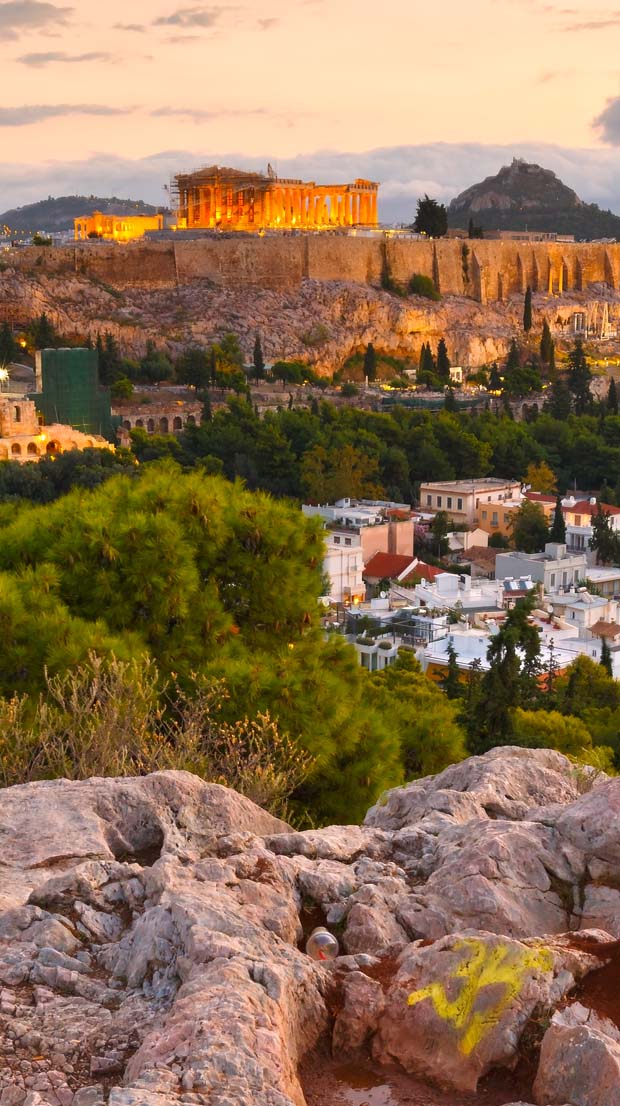
Further reading: Sydney Morning Herald "The Parthenon, as much a symbol of Greece as the drachma once was. "
See this paragraph from the Financial Times:
"European Union officials on Tuesday were scrambling to make sense of a surprise decision by George Papandreou, the Greek prime minister, to call a referendum on the country’s most recent bail-out package."
Nearly all comment from the eurozone leadership is negative on Papandreou's decision, and Finland Minister of Foreign Affairs Alexander Stubb said the vote was essentially a vote on Greek membership in the eurozone. Papandreou cited the need to gain political backing from Greek politicians in order to proceed with the latest debt-loan deal hammered out last week. With more painful austerity cuts and a horizon of endless strikes and demonstrations ahead for Athens, Papandreou's call for a referendum vote may be the only viable way to proceed politically. The vote should extablish, at least for a bief respite in the Greek body politic, that when it comes to the 'troika' orchestrated austerity plan the Greeks are either "in" or "out."
The option being put to the Greek political body seems to have confused the rest of Europe, though. See this also from that Financial Times article:
"The ill-timed and misguided decision to hold a referendum is the political equivalent of smashing rare and expensive plates at a restaurant when one is happy,” one European diplomat said. “The meaning of this eludes everyone."
If Papandreou loses the confidence vote, will Greece quickly default?
Eurostat has released data showing that Greek unemployment rose to 17.6% in July 2011.
Greek history held hostage to the present
"Papandreou acknowledges that Greeks face a monumental or seemingly Sisyphean task of rebuilding the economy, which is forecast to shrink by 5.5 percent this year. But he has portrayed himself as an optimist, believing that the crisis-driven change will forge lasting improvements."
Full article by Ken Maguire at the Global Post.
"German Finance Minister Wolfgang Schaeuble said the reduction of Greece’s debt by means of private sector participation must be bigger than agreed in July by euro region leaders in order to achieve a “sustainable solution” for the over-indebted country."
Brief item at Bloomberg
"Reduce the Size of the state" Troika primary demand

TOP PAGES: